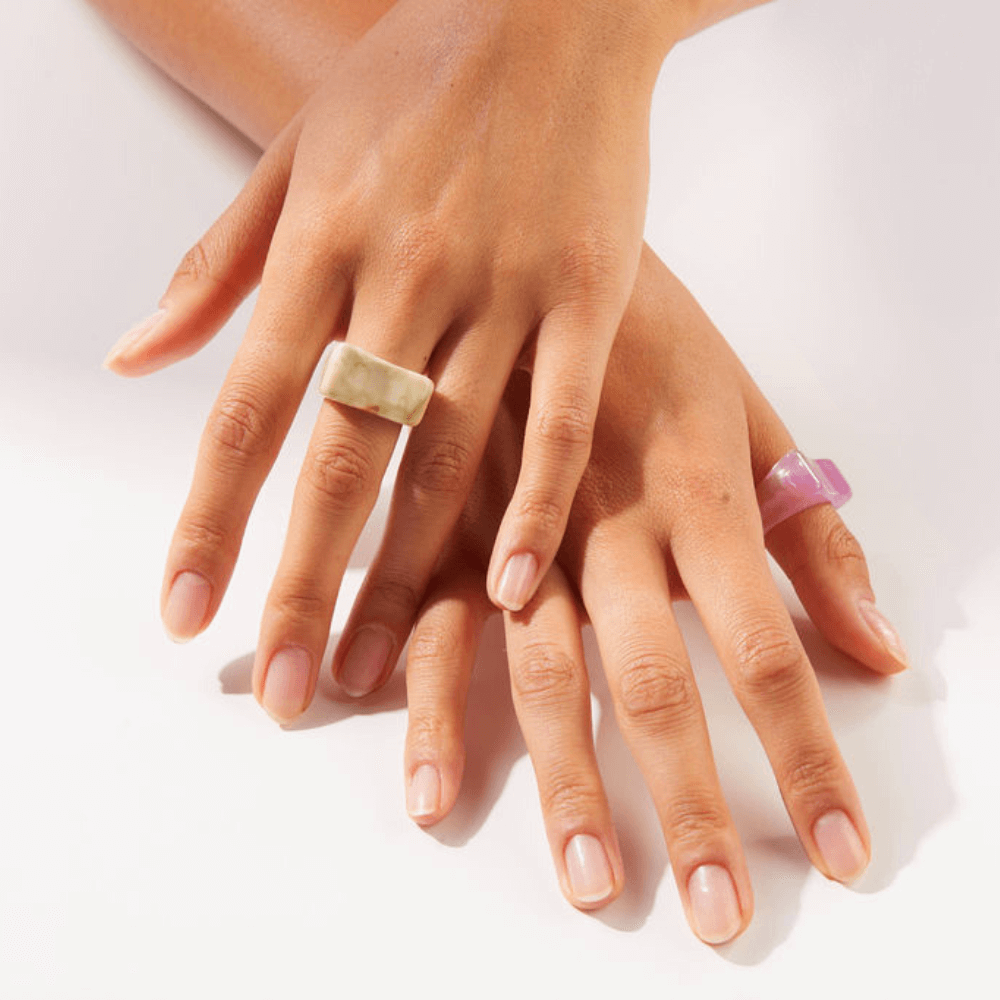


Scroll through any nail inspiration feed lately and you'll notice something: the loudest trend right now is quiet. No chrome, no ombré, no six-week gel set — just clean, buffed, healthy-looking nails with barely any polish at all, sometimes none. It's showing up on Pinterest boards and TikTok get-ready-with-me videos under names like "minimalist nails" and the "no-polish manicure," and it's stuck around long enough that it stopped looking like a passing trend.
It's easy to write it off as another aesthetic swing of the pendulum. But when we looked at why this particular look is catching on, and what's actually happening to nails that go through it, the appeal turned out to be more than visual. Minimalist nails may be one of the only manicure trends a dermatologist would genuinely recommend.
What Counts as a "No-Polish" Manicure?
A no-polish manicure isn't the same as bare, neglected nails. It usually means shaping and buffing the nail plate to an even, glossy finish, conditioning the cuticle instead of cutting it, and finishing with either nothing, a sheer strengthening coat, or a barely-there wash of color. The nail itself is the star, not what's painted on top of it.
It swaps the six-step polish or gel process, base coat, color, top coat, cure, soak-off, repeat, for a much shorter routine built around the nail's actual condition instead of a color that has to be maintained. That distinction matters more than it sounds like it should.
The Real Reason This Trend Is Catching On
Search interest in "no polish manicure" has stayed unusually steady for months, and it comes with something most nail-design trends don't: search engines are already surfacing a full People Also Ask panel and an AI-generated overview every time someone looks it up. That's a sign this isn't a fleeting design fad so much as a genuine shift in how people want to care for their nails.
The reason tracks with what's happening at a structural level. A nail plate is built from layers of keratin, held together by lipids and moisture. Every cycle of polish, and especially gel or acrylic, adds stress to that structure: acetone removers dissolve the lipids holding the nail's layers together, filing thins the plate to help product adhere, and the removal process itself, soaking, scraping, occasionally peeling, can take healthy nail with it. None of that is dramatic in a single manicure. It adds up over years of repeated cycles.

That's really the founding idea behind Dr. Dana as a brand: the damage from polish usually isn't the color itself, it's the process around it. Gel needs UV curing and acetone soaking to come off. Acrylic needs filing down to the natural nail before a fresh set goes on. Even regular polish, removed weekly, means weekly contact with a solvent strong enough to strip lipids. A minimalist manicure removes most of that process. There's no soak-off, no filing down to rough up the surface for adhesion, no weekly reapplication of acetone. The nail gets to just be a nail for a while, which is precisely the point.
That also explains why this trend, unlike a lot of nail content, isn't really about a season or a color story. It's not competing with french tips or chrome for the same moment on your feed. It's positioned more like a reset in between those looks, which is part of why it keeps resurfacing instead of fading after one news cycle.
Not sure whether your nails need a full reset or just a lighter routine? Take Dr. Dana's free Nail Health Check-In for a personalized read in a couple of minutes.
How Long Does a No-Polish Manicure Last, How Often Should You Get One, and What Does It Cost?
Because there's no chip to watch for, a no-polish manicure holds up differently than a color manicure. A buff-and-shine finish typically looks fresh for two to three weeks, and most people stretch cuticle and shine maintenance to about once every three to four weeks at home in between salon visits, if they go to a salon at all.
That timeline is also the appeal for anyone easing off gel or acrylics. Minimalist nails give the nail plate a genuine rest period without leaving hands looking unfinished in the meantime. It's less "no manicure" and more "manicure, minus the parts that were hardest on your nails."
On cost, a salon "bare" or "no-polish" service usually runs less than a full color or gel appointment, since there's no product to apply or remove, roughly the price of a basic buff-and-shine. Done at home with a buffing block, a prep step, and cuticle oil you already own, the ongoing cost is close to zero after the initial kit.
How to Get the Look at Home

The at-home version isn't a treatment, it's a short ritual, closer to skincare than to a manicure appointment. It comes down to three steps, and none of them take more than a few minutes:
1. Prep the nail plate. A gentle glycolic prep clears away buildup and dead surface cells, so the next two steps actually absorb instead of sitting on top.
2. Buff, don't file down. A fine buffing block smooths ridges and creates a natural shine without thinning the nail the way a coarse file does.
3. Feed the cuticle nightly. A penetrating cuticle oil is the step that actually makes minimalist nails look intentional rather than just plain. It's what gives the finished look its glow, and it's the habit doing the most long-term work for nail health.
That sequence, glycolic prep, buffing, nightly hydration, is close to exactly what's inside the Dr. Dana Nail Renewal System: it was built for this kind of low-intervention routine, not as a stopgap between color manicures.
Is It Worth Paying a Salon For, or Can You DIY It?
Some salons have started offering "no-polish" or "bare" manicures as their own service. But because the whole point of this look is minimal product, it's one of the more realistic manicures to do well at home. The tools involved, a buffer, a glycolic prep step, cuticle oil, are the same ones a salon would reach for, and the technique is far more forgiving than a gel application or an even ombré fade.
Even if your nails are coming off months of gel or acrylic, you don't need a salon appointment to figure out where to start. Take Dr. Dana's free Nail Health Check-In for a personalized read on your nails, then begin the routine above with the Nail Renewal System, which is built to work whether you're starting from a healthy baseline or repairing the aftereffects of a color manicure.
Ready when you are: Take Dr. Dana's free Nail Health Check-In for a personalized starting point, or go straight to the Nail Renewal System to begin the routine today.
A Trend That's Actually a Nail-Health Habit
Most manicure trends ask something of your nails, a shape, a length, a level of upkeep. This is the rare one that asks less. Whether minimalist nails stick around as a design trend or fade into the next thing, the underlying habit, less stripping, less filing, more hydration, holds up regardless of what's showing up on your feed.
That's really the throughline behind the Dr. Dana Nail Renewal System: not a treatment for a problem, but a routine built for the in-between, so your nails are in better shape whenever you do decide to pick up a bottle of polish again.